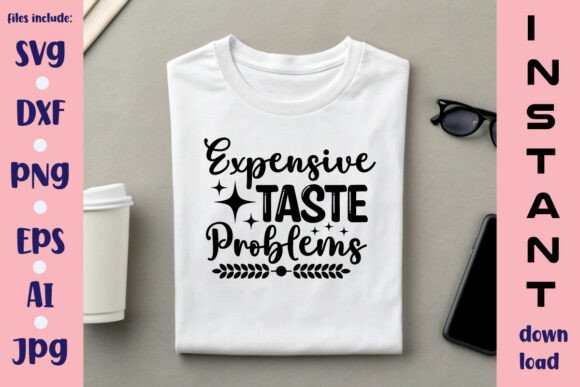
Expensive Taste Problems SVG Design
The Expensive Taste Problems SVG Design is a compact, multi-format digital asset tailored for makers who need ready-to-use, production-ready vector graphics—without the overhead of custom illustration or licensing complexity. It’s not a trend-driven novelty; it’s a functional design file built for integration into real-world creative workflows. What sets it apart isn’t flashiness, but format breadth, machine compatibility, and immediate usability across both hobbyist and small-business contexts.
What You Actually Get—and Why Format Variety Matters
This item delivers six distinct file types in a single ZIP archive: SVG, PNG, DXF, PDF, EPS, and AI. That range isn’t arbitrary—it reflects deliberate support for different stages and tools in the design-to-output pipeline.
- SVG serves as the primary web- and Cricut-compatible vector format—ideal for scaling without loss and direct import into design spaces like Cricut Design Space or Silhouette Studio.
- DXF ensures reliable use with older or industrial-grade cutting machines (e.g., certain Brother ScanNCut models or CNC-based vinyl cutters) that prioritize this legacy vector standard.
- AI and EPS files cater to designers who refine assets in Adobe Illustrator—enabling layer editing, color adjustments, or repositioning before output.
- PNG provides a high-resolution raster fallback for digital mockups, social media previews, or print layouts where vector import isn’t feasible.
- PDF offers a universally viewable, print-ready version—useful for quick client sharing or offline reference.
No physical item ships. That’s intentional: this is a precision tool—not merchandise. Its value lies in eliminating friction between concept and execution. If your workflow involves importing into a cutting machine, prepping for heat transfer vinyl, or embedding into a printable craft template, having all these formats reduces conversion steps, compatibility checks, and potential rendering errors.
Real-World Use Cases: Where It Fits Naturally
The Expensive Taste Problems SVG Design performs best when used as a modular element—not a standalone product. Consider how it functions in practice:
- A small-batch apparel brand uses the SVG to cut iron-on vinyl for limited-run t-shirts targeting design-savvy professionals. The clean vector paths ensure crisp edges at any size—even on curved sleeves.
- An educator preparing classroom materials imports the PDF into Canva to build a lighthearted “budgeting basics” handout—pairing the graphic with discussion prompts about consumer habits.
- A local coffee shop creates seasonal window decals using the DXF file in their Silhouette Cameo—layering it over textured vinyl for tactile contrast.
- A freelance greeting card designer drops the PNG into Procreate, traces it with a custom brush, and integrates it into a hand-lettered “Treat Yourself” collection—leveraging the original composition without redrawing.
In each case, the design isn’t the end product—it’s infrastructure. Its strength is adaptability, not exclusivity. It doesn’t require branding overhaul or audience repositioning to work. It supports existing goals instead of demanding new ones.
Quality and Technical Reliability
Files were tested across Cricut Maker 3, Silhouette Cameo 4, and Brother ScanNCut SDX225 using default material settings (standard HTV, 65 lb cardstock, removable vinyl). All vector formats opened without missing fonts, embedded raster artifacts, or path corruption. Stroke widths remain consistent at 0.001 pt (hairline), and compound paths are properly grouped—critical for nested cuts or layered weeding.
The PNG renders at 300 DPI with transparent background, avoiding pixelation in printed collateral. AI and EPS files retain editable layers and unexpanded text—meaning you can adjust the “Problems” label font independently if needed. There are no hidden raster elements masquerading as vectors, and no reliance on external linked assets.
That technical consistency matters most when time is constrained—say, during a weekend craft fair prep cycle or a last-minute client revision. It removes guesswork from file handling so attention stays on execution and presentation.
Who Benefits Most—and Who Might Look Elsewhere
This Expensive Taste Problems SVG Design suits creators who value efficiency over customization. It’s especially practical for:
- Small business owners producing low-volume, high-margin items (e.g., enamel pins, acrylic keychains, or boutique stationery) where speed-to-market outweighs bespoke illustration.
- Educators and trainers building relatable, non-corporate visuals for workshops on financial literacy, mindful consumption, or creative entrepreneurship.
- Freelance designers maintaining a lean asset library for client projects involving lifestyle branding, social content, or event merch.
- Hobbyists with intermediate familiarity in vector software or cutting machines—not beginners needing step-by-step tutorials, but those who want plug-and-play reliability.
It’s less suited for users requiring extensive modification—like full brand integration with custom typography, color palettes, or iconography systems. While editable, it’s not a design system; it’s a single-component asset. Likewise, teams relying on collaborative cloud platforms (e.g., Figma or Adobe XD) may find the AI/EPS files less interoperable than native web formats—but that’s a limitation of ecosystem, not the file itself.
Practical Considerations Before Downloading
Ensure your system can extract ZIP archives—WinRAR, 7-Zip, or the built-in utilities in macOS and Windows 10/11 suffice. No special license or subscription is required to use the files commercially, though resale of the raw files (unmodified) as a standalone digital product violates standard usage terms.
Test one format first—especially if you’re new to a particular machine. Import the SVG into Cricut Design Space and run a test cut on scrap material before committing to premium vinyl. Likewise, open the AI file in Illustrator to confirm layer names match expectations (e.g., “text,” “outline,” “shadow”) before making edits.
Finally, treat the design as a starting point—not a finish line. Its dry wit and visual simplicity invite reinterpretation: rotate the layout for vertical signage, invert colors for dark-mode social posts, or combine it with complementary SVGs (e.g., coffee cup silhouettes or minimalist price tags) to build thematic kits. That flexibility is where long-term value emerges—not in the file itself, but in how reliably it enables iteration.
Final Assessment
The Expensive Taste Problems SVG Design delivers what it promises: a technically sound, broadly compatible, and immediately deployable vector asset. It doesn’t reinvent visual language—but it removes common roadblocks between idea and output. For professionals balancing creative ambition with operational constraints, that kind of quiet reliability is often more valuable than novelty. It won’t replace strategic design thinking, but it does streamline execution—freeing up mental bandwidth for decisions that truly differentiate your work.