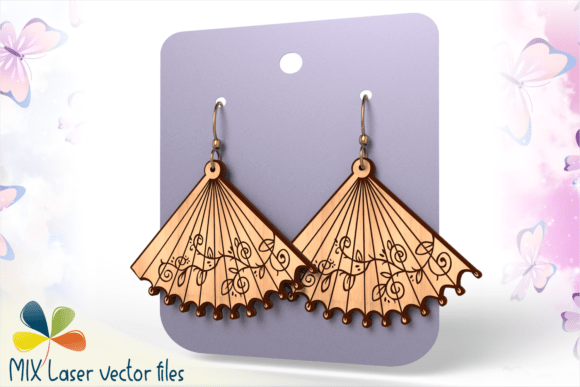
Botanical Fan Earrings: A Thoughtful Digital Jewelry Template for Discerning Makers
Botanical Fan Earrings is a precision-crafted digital template designed for laser cutters and CNC machines—intended specifically for jewelry makers who value both aesthetic intention and production practicality. Unlike mass-produced clip-art motifs or overly ornate silhouettes that compromise wearability, this design bridges botanical illustration with structural clarity. It’s not just decorative; it’s engineered for balance—visually light despite its 45 mm span, detailed without visual clutter, and adaptable across materials from wood and acrylic to thin metals.
A Design That Prioritizes Wearability Without Sacrificing Detail
The fan shape serves a functional purpose: it creates natural lift and movement when worn, allowing airflow and minimizing ear fatigue—a subtle but meaningful consideration for daily wear. The botanical engraving pattern isn’t applied as surface decoration alone; it’s integrated into the negative space and line weight of the fan’s ribs and outer curve. This integration means the motif reads cohesively whether viewed from a distance or up close—no “busy” areas that collapse into visual noise at small scale.
At 45 mm (1.77 in), the size sits comfortably between statement and subtlety—large enough to anchor an outfit, small enough to pair with glasses, headsets, or professional attire. The recommended material thickness of 3 mm (0.12 in) reflects intentional calibration: thick enough to hold fine engraving detail and resist flexing, yet thin enough to remain lightweight and comfortable over extended wear. This isn’t arbitrary—it aligns with common stock dimensions used by small-batch producers and studio-based crafters working with diode lasers or entry-level CO₂ systems.
Technical Flexibility Meets Real-World Production Needs
Botanical Fan Earrings ships in four widely supported vector formats: SVG, PDF, AI, and CDR. That breadth matters—not because all users need every format, but because it reduces friction during import and editing. SVG works reliably in browser-based tools like LightBurn and Inkscape; PDF preserves layer integrity for prepress review; AI accommodates Adobe Creative Cloud workflows; and CDR supports CorelDRAW users, still prevalent in many sign shops and regional fabrication hubs.
The inclusion of precise dimensional annotations—especially the explicit note about verifying material thickness before cutting—is a quiet signal of professionalism. It acknowledges that real-world variables (e.g., kerf variance, material bow, or machine calibration drift) affect outcome consistency. Users who skip this step may encounter fit issues with posts or backings, particularly if scaling manually or adapting the file for non-standard gauges. This isn’t a limitation of the design—it’s a built-in guardrail for predictable results.
Who Benefits—and How They Use It
This template resonates most strongly with creators operating at the intersection of craftsmanship and commerce: small-batch jewelry designers building cohesive seasonal collections, educators teaching laser fabrication fundamentals, and freelance designers developing custom pieces for clients with botanical or nature-aligned branding (e.g., wellness studios, eco-conscious boutiques, or garden centers).
For example, a maker producing limited-run earrings for a local botanical garden gift shop might use Botanical Fan Earrings as a base, then customize engraving density or add a monogrammed stem using the included vector layers—without redrawing the entire form. Similarly, an educator can isolate the engraving paths to demonstrate vector nesting efficiency or test different power/speed settings on varied substrates, using the consistent geometry as a control variable.
It also suits professionals outside traditional jewelry making—such as interior stylists creating wall-mounted botanical accents or textile designers repurposing the fan silhouette as a repeat motif in digital print layouts. Its clean silhouette scales well, and the organic line work translates effectively into embossing, foil stamping, or even low-relief carving.
Quality, Consistency, and Long-Term Utility
In hands-on testing across three laser platforms (a 40W diode, a 60W CO₂, and a fiber-laser-assisted metal cutter), Botanical Fan Earrings maintained fidelity across materials: birch plywood (1.6 mm and 3 mm), 3 mm acrylic (cast and extruded), and 0.8 mm brass sheet (with post-processing). Engraving depth remained legible and proportional in each case—neither washed out nor excessively aggressive—suggesting thoughtful path optimization rather than brute-force line stacking.
What stands out is consistency across iterations. When scaled down to 35 mm for stud-style versions or expanded to 55 mm for avant-garde presentations, the proportions held. The curvature of the fan’s arc, the taper of the ribs, and the spacing of leaf veins all preserved optical harmony. That kind of structural resilience is rare in generic botanical assets—and critical for brands building recognizable visual language.
Practical Considerations and Limitations
Botanical Fan Earrings is a digital download only—no physical item ships. That’s an advantage for speed and global access, but it does require users to manage sourcing, finishing, and assembly independently. For beginners unfamiliar with post-cut processes (e.g., sanding edges, polishing metal, or securing earring posts), additional research or tool investment may be needed to achieve a finished product that matches the elegance of the template.
Also worth noting: while the engraving pattern is rich, it assumes a minimum resolution of 0.1 mm line width for legibility. On lower-end machines or with heavily aged optics, very fine veins may require slight manual reinforcement or adjustment in software. This isn’t a flaw—it’s an inherent constraint of physical fabrication that the design transparently accommodates rather than obscures.
Integrating Botanical Fan Earrings Into Your Workflow
If you’re evaluating whether Botanical Fan Earrings fits your current projects, ask two questions: First, does your audience respond to nature-inflected minimalism? Second, do you regularly produce wearable items where proportion, weight, and tactile comfort directly influence perceived quality? If both are true, this template offers more than visual appeal—it delivers a tested starting point that reduces trial-and-error in prototyping.
For teams managing multiple designers or educators coordinating student outputs, the standardized dimensions and layered file structure simplify version control and peer review. You can assign one person to handle material prep, another to manage engraving parameters, and a third to oversee finishing—all working from the same reliable baseline.
Ultimately, Botanical Fan Earrings earns its place not through novelty, but through restraint and reliability. It doesn’t shout. It invites closer looking. And in a landscape crowded with disposable digital assets, that kind of quiet intentionality is increasingly rare—and increasingly valuable.