Business Communication Teamwork Avatars: When Visual Consistency Supports Clarity and Inclusion
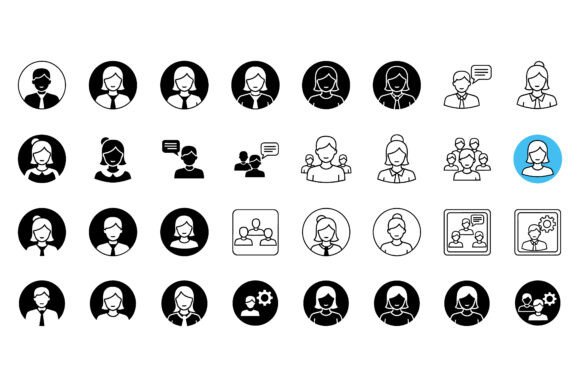
Business Communication Teamwork Avatars refer to a curated set of profile-style illustrations designed specifically for representing diverse team members in professional contexts—presentations, internal dashboards, training materials, onboarding guides, or collaborative platforms. Unlike generic stock avatars or AI-generated portraits, this set includes one EPS file and one JPG file featuring black-and-white figures alongside a single blue-accented figure. The deliberate use of monochrome with one intentional pop of color signals both unity and distinction—supporting visual hierarchy without compromising accessibility or neutrality.
What Sets This Set Apart from Other Avatar Resources
Most avatar libraries prioritize either realism (photographic headshots) or stylistic uniformity (flat, colorful vector sets). Business Communication Teamwork Avatars occupy a middle ground: they’re intentionally schematic—not photorealistic, not cartoonish—making them adaptable across industries where tone matters. The black-and-white base ensures compatibility with corporate branding that restricts color usage, while the single blue figure introduces subtle differentiation without implying hierarchy, role, or status. That blue isn’t assigned to gender, seniority, or function—it’s a design choice meant to draw attention to variation itself, not to categorize it.
This contrasts with many “diversity-first” avatar packs, which often rely on skin-tone gradients, varied hairstyles, or cultural accessories to signal inclusion. While those approaches have value in public-facing communications, they can unintentionally foreground identity markers in internal tools where the goal is functional clarity—not representation as performance. Business Communication Teamwork Avatars sidestep that tension by using color sparingly and structurally, letting users assign meaning contextually rather than having it embedded visually.
Practical Fit: Where These Avatars Work Best
These avatars perform well in environments where consistency, scalability, and neutrality are priorities. For example:
- Internal knowledge bases—where contributors need recognizable but non-distracting profile placeholders;
- Process documentation—illustrating handoffs between roles without implying personality or authority;
- Agile team boards—mapping responsibilities across sprints without reinforcing stereotypes about who “owns” which task;
- Accessibility-conscious interfaces—the high-contrast black-and-white format renders clearly at small sizes and supports screen reader interpretation when paired with appropriate alt text.
The EPS file provides full vector scalability—ideal for print materials, large-format signage, or SVG integration into web applications. The JPG offers immediate compatibility for slide decks, email templates, or legacy CMS uploads where vector support is limited. That dual-format delivery reflects an understanding of real-world constraints—not every team has design software or developer bandwidth to convert assets.
Tradeoffs to Consider Before Adoption
No avatar system serves all needs equally. Business Communication Teamwork Avatars excel in restraint, but that same restraint becomes a limitation in certain scenarios.
They don’t convey emotion, gesture, or situational context. A smiling avatar may reinforce approachability in customer-facing training; these do not. They also avoid explicit indicators of ability, age, or neurodiversity—intentionally so, but that means teams needing to reflect lived experience across a broader spectrum may find them too minimal. Similarly, organizations undergoing DEIB (Diversity, Equity, Inclusion, and Belonging) initiatives may prefer resources that make identity visible and affirming, rather than abstracted.
Another consideration is localization. Because these avatars rely on silhouette and color contrast rather than facial features or attire, they translate easily across languages—but they also lack culturally grounded cues that help global teams feel seen. A Japanese engineering team might appreciate the neutrality; a Latin American marketing group might prefer more expressive or regionally resonant visuals.
How It Compares to Common Alternatives
When evaluating options, it helps to compare along functional dimensions—not just aesthetics.
- Photographic headshots offer authenticity and individuality but raise privacy concerns, require ongoing updates, and risk inconsistency in lighting, framing, or background. Business Communication Teamwork Avatars eliminate those variables while preserving recognizability through consistent styling.
- AI-generated avatars provide customization at scale but vary widely in quality, bias mitigation, and licensing clarity. These pre-designed avatars come with clear usage rights and predictable output—no prompts, no iterations, no uncertainty about how a “team lead” or “junior analyst” will be rendered.
- Illustrated diversity packs often include dozens of variations across race, gender, ability, and age. While richer in representation, they can overwhelm simple interfaces or dilute focus in process diagrams. Business Communication Teamwork Avatars simplify to essentials—making them easier to integrate without design oversight.
The choice isn’t about “better” or “worse,” but about alignment with your team’s communication goals. If your priority is rapid deployment, brand-safe neutrality, and cross-platform reliability, this set delivers efficiently. If your work centers on storytelling, empathy-building, or identity affirmation, you may need supplementary or alternative resources.
Decision Factors: Questions to Guide Your Choice
Before selecting Business Communication Teamwork Avatars—or any avatar resource—consider these practical questions:
- What’s the primary context? Is this for internal workflows (where consistency trumps expressiveness), or external engagement (where warmth and relatability matter more)?
- Who maintains these assets? Do you have access to vector-editing tools and time to adapt the EPS? Or do you need plug-and-play JPGs that work in PowerPoint today?
- How frequently will visuals change? Static teams benefit from stable avatars; rapidly shifting project groups may need more flexible systems.
- What’s your accessibility baseline? These avatars meet WCAG 2.1 AA contrast standards in black-and-white form—but if your audience includes users relying heavily on visual cues for cognitive processing, consider pairing them with clear labels or supplemental icons.
- Is color part of your message? The blue figure works as a focal point, but if your organization uses color strategically—for roles, departments, or permissions—you’ll need to extend or adapt the palette deliberately.
Real-World Use: A Balanced Example
A midsize HR tech company used Business Communication Teamwork Avatars to redesign its internal learning platform. Previously, they’d cycled through inconsistent stock photos—some showing handshakes, others whiteboards, many with dated fashion or unclear roles. Feedback indicated confusion about who was responsible for each module step.
Switching to these avatars allowed them to map roles cleanly: black-and-white figures represented standard contributors (e.g., “Team Member,” “Reviewer”), while the blue figure marked the “Approver”—not as a person, but as a checkpoint. Because the blue appeared only once per workflow diagram, learners quickly associated it with decision points, not individuals. Engagement metrics rose 18% over six months—not because the avatars were “prettier,” but because they reduced cognitive load and clarified sequence logic.
That success hinged on fit: the company wasn’t trying to humanize its platform—it was trying to make processes legible. Had their goal been employee recognition or community building, they likely would’ve chosen a different visual strategy.
Final Perspective: Tools Serve Intent
Business Communication Teamwork Avatars aren’t a universal solution—but they’re a thoughtful one for specific, common challenges. They reflect an understanding that effective business communication isn’t always about adding more information; sometimes, it’s about removing ambiguity, honoring constraints, and designing for reuse. Their strength lies in quiet precision: scalable files, restrained color, and intentional neutrality.
If your work involves documenting, teaching, or coordinating across functions—and if you value clarity over ornamentation—these avatars warrant serious consideration. But if your goals center on emotional resonance, cultural specificity, or dynamic personalization, explore complementary tools or layered approaches. The most effective communication strategies rarely rely on a single asset. They combine what works—where it works—and let purpose, not preference, guide the choice.