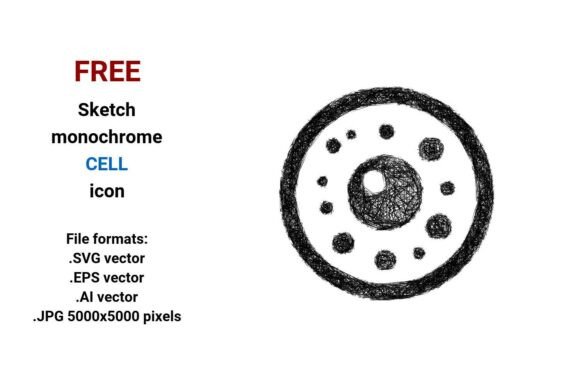
Free Sketch Cell Icon Collection: High-Quality Biological Cell Icons for Designers & Educators
What Is a Sketch Cell Icon — and Why Does It Matter?
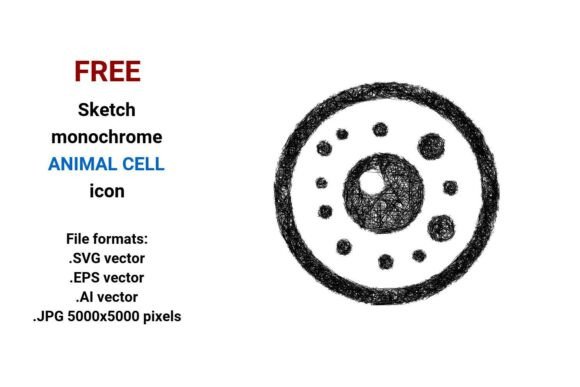
A sketch cell icon is a hand-drawn–style digital representation of a biological cell, designed to convey scientific accuracy while retaining an approachable, human touch. Unlike photorealistic or highly technical illustrations, sketch-style cell icons use rough sketchy lines, soft curves, and subtle hatch textures to evoke the feeling of a biologist’s notebook or a classroom whiteboard diagram. These icons are especially valuable in UI/UX design, educational platforms, science apps, and biology-themed dashboards — where clarity, visual warmth, and scientific credibility must coexist.
Why Choose Free Sketch Black and White Cell Icons?
Black-and-white sketch cell icons offer unmatched versatility. Without color distractions, they integrate seamlessly into any interface — whether it’s a minimalist website dashboard, a medical ecommerce platform, or an interactive biology learning app. Their monochrome nature ensures accessibility (meeting WCAG contrast standards), simplifies theming, and supports consistent branding across light/dark modes. Moreover, the sketchy line icon aesthetic signals approachability — making complex topics like cellular structure feel less intimidating to students, patients, or general users.
Four File Formats, One Powerful Asset
This free collection delivers each biological cell icon in four essential formats — ensuring compatibility with every stage of your creative workflow:
- .SVG vector — Perfect for web use. Scales infinitely without pixelation, loads quickly, and supports CSS styling and animation. Ideal for website headers, app interfaces, and responsive dashboard widgets.
- .EPS vector — Industry-standard for print and high-resolution output. Used by professional designers in Adobe Illustrator, CorelDRAW, and prepress workflows. Great for lab posters, textbook figures, or presentation handouts.
- .AI vector — Native Adobe Illustrator format. Offers full layer control, editable paths, and easy customization (e.g., adjusting stroke weight, adding labels, or modifying organelle outlines). A must-have for designers building custom cell button sets or icon art systems.
- .JPG (5000×5000 pixels) — High-res raster version for immediate use in presentations, social media graphics, or legacy software that doesn’t support vectors. Maintains crisp detail even when zoomed — useful for zoomable biology infographics or digital textbooks.
Understanding Vector Images: Why “Scalable” Isn’t Just Marketing Jargon
A vector image isn’t made of pixels — it’s built from mathematical equations that define points, lines, curves, and shapes. That means whether you display your cell icon as a 16-pixel favicon or a 3-meter-wide conference banner, it stays razor-sharp. This is fundamentally different from raster images (like standard JPGs or PNGs), which blur or pixelate when enlarged. For educators creating scalable lesson slides, developers building adaptive UIs, or startups designing cohesive brand assets, vector format isn’t optional — it’s foundational.
Real-World Uses Across Industries
These sketch cell icons go far beyond decorative flair. Here’s how professionals apply them meaningfully:
- Educational Technology: Biology learning apps use drawn cell icons as interactive navigation elements — tapping a mitochondrion icon opens a 3D model; selecting a nucleus icon launches a DNA replication animation. The playful, casual sketch style reduces cognitive load for younger learners.
- Healthcare & Telemedicine Platforms: Patient-facing dashboards incorporate biological cell button elements to organize health metrics — e.g., a rough sketch icon of a red blood cell links to hemoglobin reports, while a stylized neuron represents neurological assessments.
- Scientific Publishing & Research Tools: Journals and open-access repositories use minimalistic, outline-based cell icons to label figure panels, categorize datasets, or tag open-source code repositories related to cell biology.
- Startup Branding & SaaS Interfaces: Biotech startups building CRISPR analytics tools or microbiome tracking software choose sketchy, pencil-drawn icons to signal innovation, transparency, and human-centered science — distinguishing themselves from sterile, corporate competitors.
Common Misconceptions — Clarified
Misconception #1: “Sketchy = Unprofessional.”
Not at all. In modern UI design, intentional sketch aesthetics communicate authenticity and user empathy — think of Google’s Material You or Apple’s SF Symbols, which embrace subtle irregularities to feel more human. A rough sketch icon of a cell signals that science is exploratory, collaborative, and accessible — not cold or exclusive.
Misconception #2: “Black and white means boring.”
On the contrary — monochrome sketch icons gain expressive power through line weight, spacing, and negative space. A well-designed biological cell icon in black and white can highlight structural hierarchy (e.g., thicker strokes for the cell membrane, delicate hatching for cytoplasm) while remaining instantly recognizable at small sizes — critical for mobile interfaces or touch targets.
Misconception #3: “Any cell drawing works for digital use.”
No. Generic clipart often misrepresents organelles, omits key features (like nuclear pores or microvilli), or uses inconsistent scale. These free sketch cell icons are grounded in accurate biology fundamentals — showing a eukaryotic animal cell with proportional nucleus, Golgi apparatus, ribosomes, and endoplasmic reticulum — making them trustworthy for both teaching and professional contexts.
How to Use These Icons Responsibly & Effectively
Even free resources carry design responsibility. Here’s how to maximize impact:
- Match context to style: Use the scribble icon variant for brainstorming tools or student-facing content; opt for the cleaner outline version for clinical dashboards or regulatory documentation.
- Ensure consistency: If pairing with other icons (e.g., DNA, microscope, petri dish), verify stroke width, corner radius, and visual weight align — many design systems fail because of mismatched design elements.
- Optimize for performance: Prefer SVG for web. Compress JPGs using modern tools (like Squoosh) before embedding — especially important for ecommerce product pages where speed affects conversion.
- Attribute appropriately: Though free for personal and commercial use, always check the license. Reputable sources clearly state usage rights — supporting ethical, sustainable design practices.
Why This Collection Stands Out
Unlike generic icon packs, this set was created with biology educators, UX researchers, and front-end developers in mind. Each cell vector image balances anatomical fidelity with stylistic warmth — no oversimplified blobs or cartoonish exaggerations. The curved, organic linework reflects how real cells look under magnification: dynamic, asymmetrical, and alive. And because it includes .AI, .EPS, .SVG, and .JPG, you’re never locked into one tool or use case.
Whether you’re prototyping a new science education app, designing a university course website, building a biotech startup’s investor deck, or illustrating a children’s biology book, these free sketch cell icons serve as reliable, expressive, and scientifically grounded design elements. They turn abstract concepts — mitosis, diffusion, protein synthesis — into intuitive visual anchors.
Get Started Today — No Signup, No Paywall
Download the full set instantly: four formats, zero cost, no attribution required. Because great cell icon design shouldn’t be a barrier — it should empower clearer communication, deeper learning, and more inclusive science experiences. Whether you're a high school teacher preparing a lesson on cellular respiration, a developer integrating biology data into a healthcare API, or a designer crafting a modern, minimalistic dashboard — this resource meets you where you are.
Remember: In an age of AI-generated imagery and algorithmic design, the thoughtful, hand-crafted sketch icon remains uniquely human. It says, “Science belongs to everyone — and understanding begins with a simple, honest line.”