FREE Sketch Accordion Icon: A Practical Resource for Designers and Developers
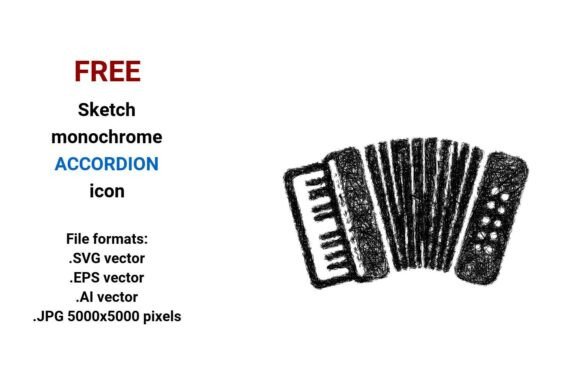
A FREE Sketch Accordion Icon is a hand-drawn, monochrome vector asset designed to represent the accordion — a musical instrument known for its bellows-driven sound and expressive range. Unlike photorealistic or flat UI icons, this version embraces a sketchy, freehand aesthetic: visible pencil strokes, subtle hatching, and deliberate imperfections that evoke authenticity and human touch. It’s not just decorative — it’s functional. And because it’s offered in four widely supported formats (.SVG, .EPS, .AI, and high-res .JPG), it bridges creative flexibility with technical reliability.
What Makes This FREE Sketch Accordion Icon Distinct?
The distinction lies in intentionality. While many accordion icons prioritize clarity or minimalism, this one leans into expressive line art — think interface sketches you’d see in early-stage UX wireframes or branding mood boards. Its monochrome, black-and-white palette ensures consistency across light and dark modes, while the sketchy outline supports visual storytelling in contexts where polish isn’t the goal. It works equally well as a button accordion element in a music education app or as an illustrative touch in a cultural nonprofit’s website.
Crucially, the inclusion of both vector and raster formats expands usability. The .SVG file scales infinitely without quality loss and integrates cleanly into web interfaces. The .EPS and .AI files support full editability in Adobe Illustrator and legacy design workflows. The 5000×5000-pixel .JPG provides a crisp, print-ready fallback — useful for presentations, posters, or documentation where vector support isn’t available.
How It Compares Across Styles and Formats
Not all accordion icons serve the same purpose. Flat, geometric icons (often found in icon libraries like Font Awesome or Material Icons) excel in navigation bars and mobile apps where clarity and consistency matter most. In contrast, the FREE Sketch Accordion Icon trades pixel-perfect uniformity for character — making it better suited for landing pages, editorial illustrations, or brand identities that value approachability over austerity.
Compared to other sketch-style assets, this one avoids over-rendering. There’s no excessive texture, noise, or simulated paper grain — just clean, confident lines. That restraint makes it more adaptable than heavily stylized “grunge” or “vintage” alternatives, which can clash with modern layouts or accessibility requirements.
Format-wise, the .SVG stands out for web use: lightweight, accessible (with proper aria-label or title attributes), and compatible with CSS animations. The .EPS and .AI files are ideal for designers who need to adjust stroke weight, recolor elements, or integrate the icon into larger vector compositions — say, a custom illustration for a music festival poster. The .JPG, while not scalable, offers immediate compatibility with platforms that don’t accept vectors (e.g., certain CMS editors or email builders).
Strengths and Real-World Fit
This FREE Sketch Accordion Icon shines when authenticity and context align. For example:
- A music teacher building a WordPress site might embed the .SVG version into a “Lessons” section header — its sketchy style subtly reinforces the hands-on, learning-focused tone.
- A startup developing a music theory app could use the .AI file to modify the icon into a series of interactive states (e.g., expanded/collapsed), leveraging the vector paths for smooth transitions.
- A graphic designer crafting a brochure for a folk music archive might layer the .EPS version with halftone textures or offset printing effects — something only editable vectors allow.
Its monochrome nature also simplifies accessibility compliance. With sufficient contrast against backgrounds and clear labeling, it meets WCAG 2.1 standards more readily than multicolored or low-contrast alternatives.
Tradeoffs and Limitations to Consider
No single icon format or style fits every scenario. Because this is a sketch accordion icon, it’s less suitable for interfaces requiring strict visual hierarchy or dense icon grids — where uniform stroke weights and alignment improve scannability. Similarly, if your project mandates strict brand guidelines with defined color palettes, the black-and-white constraint may require additional customization work.
The .JPG, while high-resolution, cannot be resized upward without pixelation — so it shouldn’t be used as a primary web asset unless compressed and served responsively. And while the .SVG is versatile, designers unfamiliar with inline SVG optimization may inadvertently bloat page load times if they embed unminified code or omit viewBox attributes.
Also worth noting: as a line art interpretation, it assumes viewer familiarity with the accordion’s silhouette. Those designing for global or novice audiences may want to pair it with a brief label — especially since some stylized accordions blur the distinction between bellows, buttons, and reeds.
When to Choose This Over Other Options
You’ll likely find the FREE Sketch Accordion Icon most valuable when your goals include:
- Expressing craft or process — e.g., in portfolios, design system documentation, or educational tools where “how it’s made” matters as much as “what it does.”
- Supporting a casual, human-centered brand voice — startups, indie publishers, or community projects often benefit from the warmth of sketchy line work over sterile geometry.
- Needing cross-format flexibility — teams working across web, print, and presentation media gain efficiency from having one source asset adapted across outputs.
- Integrating into sketch-based UI flows — such as Figma or Adobe XD wireframes where a mobile sketch icon or UX sketch icon helps stakeholders visualize interactions before final design.
Conversely, consider alternatives if you need:
- Animated or interactive variants (e.g., a button accordion that visually expands on hover — which would require custom development beyond static assets).
- Icons optimized for small screen sizes (<16px), where fine sketch details may blur or disappear.
- Multi-language or culturally specific interpretations — this version reflects a Western concert accordion form, not regional variants like the diatonic button accordion used in Irish trad or the bayan in Eastern Europe.
Using It Thoughtfully in Your Workflow
Start by evaluating where the icon appears in context. If it’s part of a button accordion component, test its legibility at multiple sizes and contrast levels. For web use, prefer the .SVG — but run it through a tool like SVGOMG to reduce file size and remove unnecessary metadata. When placing it in print layouts, open the .EPS or .AI file to confirm stroke alignment and avoid unintended gaps or overlaps.
If you’re building a design system, treat this as a “tone-setting” asset rather than a utility icon. Its strength lies in reinforcing voice and values — not replacing standardized navigation elements. Pair it with consistent typography and spacing to maintain cohesion, and always provide text alternatives for screen readers.
Finally, remember that a FREE Sketch Accordion Icon is one tool among many. Its value multiplies when chosen deliberately — not because it’s free, but because its sketchy line art, monochrome fidelity, and format versatility match your project’s practical and expressive needs.