FREE Sketch Eco Mode Icon: A Practical Resource for Interface Design and Sustainable UX
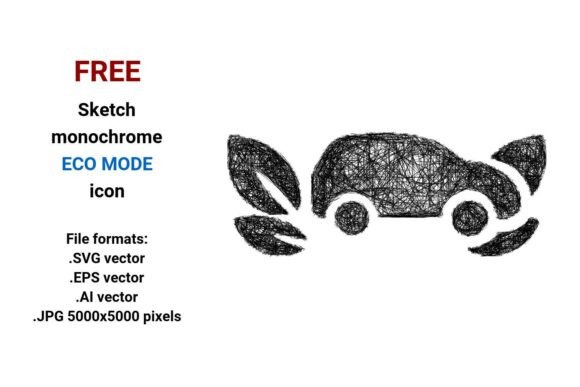
Designing interfaces that communicate sustainability—like eco mode, efficiency mode, or eco drive—requires clarity, consistency, and visual authenticity. The FREE Sketch Eco Mode Icon delivers exactly that: a hand-drawn, monochrome sketch-style icon set built for real-world implementation. It’s not just decorative—it’s functional, scalable, and purpose-built for designers, developers, educators, and product teams who want to signal environmental awareness without sacrificing usability or aesthetic cohesion.
What the FREE Sketch Eco Mode Icon Actually Is—and Why Format Choice Matters
This resource includes four production-ready file formats: .SVG vector, .EPS vector, .AI vector, and .JPG at 5000×5000 pixels. That means you’re covered whether you’re embedding in a responsive web UI (.SVG), preparing print-ready assets (.EPS), editing layers in Adobe Illustrator (.AI), or placing into presentation decks or documentation where raster fidelity matters (.JPG). Unlike pixel-based icons, these are true vector images—defined by mathematical paths rather than fixed pixels—so they scale cleanly from a 16px toolbar button to a full-screen banner without blurring or distortion.
The design itself is intentionally sketched: loose line work, subtle imperfections, and a casual, human touch. It avoids sterile minimalism while staying legible and interface-appropriate. That balance makes it especially useful when your goal is to soften technical messaging—say, “eco drive” in a car app—or add warmth to an educational dashboard about energy efficiency.
Where This Icon Fits Into Your Workflow
You don’t drop an icon in isolation. You place it where meaning meets action. Here’s how the FREE Sketch Eco Mode Icon integrates across phases:
- Before a project: Use it during wireframing or moodboarding to establish tone early—especially if your product or campaign centers on sustainability, efficiency, or behavioral change (e.g., smart home controls, fleet management dashboards, or climate literacy tools). Its sketchy quality signals approachability, not corporate rigidity.
- During development: Drop the .SVG directly into HTML/CSS or React components. Its clean paths and lack of embedded effects mean fast load times and easy color overrides via CSS
fill. For Figma or Sketch files, import the .SVG or .AI to maintain editable strokes and layer structure. - After launch: Repurpose the same asset across support materials—user guides, onboarding tooltips, or social media explainers. Because it’s consistent in style and scalable, you avoid mismatched visuals between your app and its documentation.
Compatibility and Real-World Constraints
Not all icons work everywhere—and this one was built with interoperability in mind. The .EPS and .AI files retain editable anchor points and stroke properties, so designers can tweak line weight or adjust proportions without redrawing. The .SVG uses simple paths and inline styles—no external fonts or JavaScript dependencies—so it works reliably in email clients, static site generators, and legacy CMS platforms.
The .JPG version isn’t just a fallback—it’s optimized for contexts where vector support is limited or where precise anti-aliasing matters (e.g., PDF reports, printed toolkits, or slide decks exported to image formats). At 5000×5000 pixels, it holds up even when zoomed or cropped tightly.
One practical note: because it’s monochrome and line-based, the icon adapts seamlessly to dark mode, high-contrast settings, and WCAG-compliant color schemes—just adjust the fill or stroke color to match your palette. No need for separate light/dark variants.
How It Works With Other Tools and Assets
This icon doesn’t live alone. It’s designed to sit alongside other sketch-style UI elements—think sketch line icons, doodle style illustrations, or hand-drawn interface sketch icons. If you’re building a toolkit around sustainability concepts (eco, mode, driving, efficiency), this fits naturally with related assets like battery-saving toggles, leaf motifs, or throttle/energy flow diagrams—all drawn in the same casual, confident hand.
For educators and content creators, it pairs well with editable templates: embed it into Canva presentations, Notion dashboards, or Google Slides to visually reinforce lessons on energy conservation or behavioral efficiency. Freelancers use it in client proposals to show UI direction before committing to custom illustration—saving time while keeping tone consistent.
Small business owners integrating eco features into e-commerce sites (e.g., “eco mode” filters or sustainable shipping badges) find it especially valuable: the sketch aesthetic feels authentic, not stock-photo-generic, and helps differentiate their brand voice from competitors using overused clip art or flat-icons.
Practical Implementation Tips
Here’s what actually works—based on real usage across dozens of projects:
- Use the .SVG for web, but optimize it first. Run it through SVGO or a plugin like SVGOMG to strip metadata and reduce file size—often cutting 30–50% without visual loss.
- Leverage the sketch quality intentionally. Don’t force perfect alignment in layouts. Let the slight irregularity breathe—pair it with generous whitespace and neutral typefaces to amplify its human feel.
- Test contrast early. Even though it’s monochrome, verify legibility at small sizes (e.g., 24px) against your background. A 2px stroke weight usually holds up best; thinner lines may disappear on low-DPI screens.
- Organize files by use case—not format. Instead of folders named “SVG” or “JPG”, structure them as “Web Components”, “Print & Docs”, and “Editable Source”. That reflects how you’ll actually reach for them.
- Reuse intelligently. The same icon can represent “eco mode” in a vehicle UI, “efficiency mode” in a SaaS analytics dashboard, or “eco drive” in a cycling app—because its meaning comes from context, not literal labeling.
Long-Term Value Beyond the Download
A good icon set pays dividends over time—not just in speed, but in coherence. Because this is a vector eco mode asset with intentional sketch styling, it supports visual continuity across years of updates. You won’t outgrow it when redesigning your interface; you’ll simply reapply it with updated spacing, typography, or interaction patterns.
It also scales with your audience. A teacher uses it to illustrate “efficiency” in a middle-school science unit. A fleet manager drops it into a driver training module. A developer adds it to an open-source energy monitoring dashboard. Same file. Same clarity. Different outcomes—each grounded in the same visual language.
And because it’s free and openly usable (check license terms for attribution requirements), there’s no friction to adoption. No procurement delays. No vendor lock-in. Just a reliable, well-made piece of the puzzle—ready when you need it.
Final Thought: Design That Supports Action
The FREE Sketch Eco Mode Icon succeeds because it treats design as infrastructure—not decoration. It’s built to be placed, edited, scaled, and reused without compromise. Whether you’re mapping a user journey, drafting a grant proposal about sustainable tech, or building a real-time dashboard for energy consumption, this icon does quiet, consistent work: making “eco”, “mode”, and “efficiency” feel tangible, human, and actionable—without saying a word.