Watercolor Botanical Jar PNG: A Practical Guide for Designers and Makers
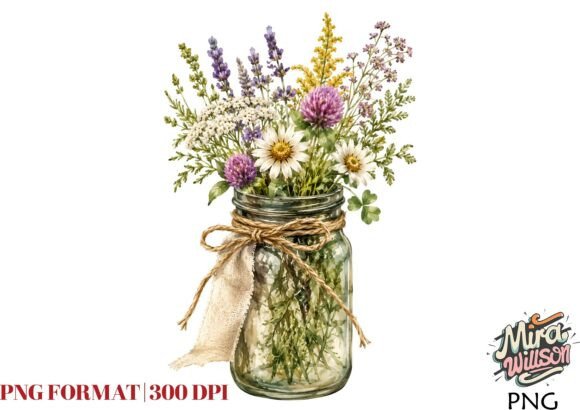
A Watercolor Botanical Jar PNG is a high-resolution digital illustration depicting a jar—often glass or ceramic—filled with delicate botanical elements like eucalyptus, lavender, ferns, or dried flowers, rendered in soft, translucent watercolor style. What distinguishes it from other botanical graphics is its intentional use of pigment texture, subtle blending, and organic imperfection—qualities that evoke hand-painted authenticity. Unlike vector-based botanicals or flat digital illustrations, this format captures the granular nuance of water media: feathered edges, gentle washes, and light-bleeding transparency. The “PNG” designation signals a raster file with a transparent background, making it ready for layering without clipping masks or manual cleanup.
How It Differs From Other Botanical Graphics
Not all botanical imagery serves the same purpose—or works equally well across applications. Vector botanicals (e.g., SVG or EPS files) scale infinitely and edit cleanly in design software, but they lack the tactile softness of watercolor. Photographs offer realism and depth but rarely include built-in transparency, require masking, and can’t be recolored non-destructively. Clipart-style PNGs often use solid fills or harsh outlines, limiting their adaptability to modern, minimalist, or artisanal contexts. In contrast, a Watercolor Botanical Jar PNG balances aesthetic warmth with functional flexibility: its 3000×3000 pixel dimensions at 300 DPI ensure sharp output for print, while the transparent background eliminates background removal steps—saving time without sacrificing fidelity.
This distinction matters most when evaluating fit for specific workflows. For example, sublimation printing on mugs or tumblers benefits from smooth gradients and edge diffusion—traits inherent to watercolor—but requires crisp resolution at final size. A low-DPI PNG may blur or pixelate; a vector might feel too clinical against matte ceramic surfaces. Similarly, scrapbooking or card design often relies on layered compositions where transparency enables intuitive stacking with paper textures, ink overlays, or handwritten typography. Here, the Watercolor Botanical Jar PNG’s natural bleed and soft opacity integrate more organically than hard-edged alternatives.
Strengths and Realistic Tradeoffs
The core strengths of a Watercolor Botanical Jar PNG lie in its visual character and production readiness. Its high resolution supports large-format prints—think framed art up to 10×10 inches at full quality—and maintains clarity even when scaled down for stickers or phone case previews. The transparent background allows drag-and-drop placement into Canva, Adobe Photoshop, Affinity Designer, or Cricut Design Space without rasterizing layers or adjusting blend modes. Because it’s a single-layer raster file, it also avoids compatibility issues sometimes seen with layered PSDs or complex vectors in beginner-friendly tools.
Yet tradeoffs exist. As a raster image, it cannot be infinitely upscaled without loss—unlike true vectors. If you need to isolate individual leaves or stems for independent manipulation (e.g., animating petals in After Effects), a layered source file would be preferable. Likewise, color customization is possible but less precise than with vector paths or editable swatches: changing hue uniformly requires adjustment layers or careful masking, not simple fill swaps. And while the watercolor aesthetic suits wellness brands, wedding stationery, apothecary labels, or nature-themed merch, it may feel incongruent with tech startups, industrial packaging, or high-contrast streetwear—contexts where bold geometry or monochrome line work often reads more clearly.
Where It Fits Best—And Where It Might Not
A Watercolor Botanical Jar PNG excels in projects where atmosphere and approachability matter more than technical precision. Consider these realistic examples:
- Sublimation product design: Applied to ceramic mugs, cotton tote bags, or polyester pillow covers, the soft edges prevent harsh halos around the jar outline—especially important on textured or off-white substrates.
- Print-on-demand greeting cards: Paired with serif typography and cream-colored stock, the illustration adds warmth without competing visually—unlike photorealistic botanicals that can overwhelm small layouts.
- Small-batch sticker sheets: When printed on matte vinyl, the watercolor grain enhances perceived craftsmanship versus glossy clipart, appealing to indie stationery shoppers.
- Digital planners or printable journals: Layered over subtle grid lines or watermark textures, its transparency preserves layout integrity while adding visual interest.
Conversely, it may fall short in scenarios requiring modular reuse. If you’re building a customizable label system where users swap out plant types, colors, or jar shapes dynamically, a vector library or SVG sprite sheet offers greater scalability. Likewise, for embroidery digitizing or laser-cut stencils, clean vector outlines are standard—not watercolor textures, which don’t translate to stitch paths or physical cut lines.
Evaluating Alternatives Thoughtfully
Before choosing a Watercolor Botanical Jar PNG, consider what problem you’re solving. Are you seeking speed and cohesion for a seasonal product launch? Then its plug-and-play transparency and consistent aesthetic deliver tangible efficiency. Are you developing a long-term brand asset library? You may want complementary formats—such as matching vector outlines or grayscale versions—for versatility across mediums.
Some designers opt to create custom watercolor illustrations from scratch using real pigments and scanning. That approach yields unique IP and total control over composition—but demands time, materials, and scanning expertise. Others license botanical photo packs, then apply watercolor filters digitally. While faster, those results often lack the nuanced layering and pigment behavior of authentic watercolor, leading to flat or artificial-looking outcomes.
A pre-made Watercolor Botanical Jar PNG sits between those extremes: it provides professional-grade execution without requiring artistic skill or equipment, yet retains enough organic character to avoid feeling generic. Its value isn’t in replacing creativity—it’s in removing friction so creative decisions stay focused on concept, audience, and context—not file prep.
Making an Informed Choice
Ask yourself three questions before committing:
- What’s my primary output medium? If it’s print-heavy (cards, posters, fabric), resolution and transparency matter more than infinite scalability. If it’s UI-driven (apps, websites, animations), SVG or multi-format bundles may serve better.
- How much editing do I anticipate? Minor resizing, color tweaks, or layering? A Watercolor Botanical Jar PNG handles that well. Frequent element isolation, shape distortion, or animation? Prioritize layered or vector sources.
- Does the aesthetic align with my audience’s expectations? Wellness, gardening, herbalism, or boutique retail audiences often respond positively to watercolor’s handmade resonance. Corporate, academic, or technical audiences may prefer cleaner, more neutral visuals.
No single format is universally superior. A Watercolor Botanical Jar PNG isn’t “better” than a vector botanical—it’s different. Its utility emerges not from technical dominance, but from thoughtful alignment: between medium and message, between workflow and outcome, between visual tone and intended emotional response. When those factors converge, it becomes less of a decorative element and more of a quiet enabler—supporting your vision without demanding attention away from it.