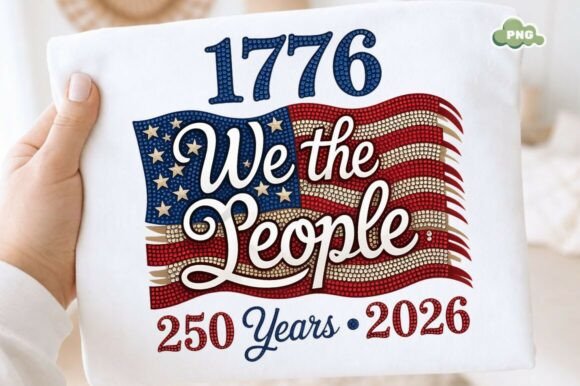
We the People 1776–2026 USA 250 PNG
If you're designing for patriotism, history education, civic celebration, or American-themed branding—this We the People 1776–2026 USA 250 PNG is more than just a graphic. It’s a precision-crafted, production-ready asset built for real-world use across digital and physical mediums. Whether you’re launching a classroom project, prepping a small-business campaign for the Semiquincentennial, or crafting commemorative merchandise, this file delivers clarity, flexibility, and immediate utility.
What Makes This PNG Stand Out?
This isn’t a low-res screenshot or a compressed web image. The We the People 1776–2026 USA 250 PNG is delivered at true 300 DPI resolution—meaning it holds crisp detail whether printed on a 24" poster or scaled down for a social media banner. Its transparent background eliminates tedious clipping or masking, so you drop it straight into design software (Photoshop, Canva, Illustrator, Affinity Designer) without extra prep time.
The typography balances gravitas and legibility: clean, historically resonant letterforms that echo the spirit of the Constitution without mimicking colonial script—so it reads clearly on a mug, a classroom handout, or a website hero section. The “1776–2026” framing signals continuity—not nostalgia—and the “USA 250” designation anchors it firmly in the upcoming Semiquincentennial milestone.
Where This PNG Adds Real Value
Professionals and creators don’t need decorative fluff—they need assets that integrate smoothly, communicate effectively, and scale reliably. Here’s where the We the People 1776–2026 USA 250 PNG earns its place in your toolkit:
- Educators: Use it on lesson slides, printable timelines, student worksheets, or bulletin board displays to visually reinforce constitutional principles and historical continuity. No copyright concerns—licensed for classroom use.
- Small Business Owners: Apply it to limited-edition apparel, local event banners, or chamber-of-commerce promotions tied to 2026. Its neutral-yet-authoritative tone works for bakeries offering “Founding Fathers Cookies” and law firms highlighting civic engagement.
- Content Creators & Bloggers: Embed it in articles about democracy, voting rights, or U.S. history milestones—without worrying about pixelation or background mismatch. Pair it with original commentary, not stock clichés.
- Hobbyists & Crafters: Print it onto iron-on transfers for t-shirts, cut it as a vinyl decal for water bottles, or layer it into digital scrapbook pages honoring family military service or naturalization stories.
- Marketers & Designers: Drop it into email headers, landing pages for patriotic sales, or branded Zoom backgrounds for virtual town halls. Its transparency means it adapts to any color scheme or layout.
Why Transparency + 300 DPI Matters More Than You Think
A transparent background isn’t just convenient—it’s essential for professional output. Without it, you’d spend minutes (or hours, across dozens of files) removing white boxes, adjusting shadows, or troubleshooting anti-aliasing halos. That time adds up—especially when iterating for client feedback or A/B testing campaign visuals.
Likewise, 300 DPI isn’t overkill if you plan to print. At 150 DPI, fine text like “1776–2026” can blur on high-end brochures or large-format signage. At 72 DPI—the standard for web-only graphics—it won’t scale cleanly beyond screen size. This PNG bridges both worlds: sharp on retina displays *and* press-ready for offset or inkjet printing.
Practical Tips for Best Results
You’ll get the most from this file by keeping a few real-world considerations in mind:
- Respect context. This design carries weight. Avoid pairing it with ironic memes, unrelated product promotions (e.g., energy drinks), or visuals that dilute its civic resonance. Let the phrase speak for itself.
- Check color contrast. While the PNG itself is black text on transparency, test how it renders against your background—especially in print. Light gray or pastel backdrops may require a subtle drop shadow or stroke for readability.
- Use vector alternatives for extreme scaling. Though 300 DPI covers most needs, if you’re blowing it up to billboard size (e.g., 10' x 20'), consider requesting or creating a vector version—PNGs are raster-based and will eventually pixelate at massive scales.
- License awareness. Confirm usage rights before commercial redistribution (e.g., bundling it into a template pack for resale). Most individual-use licenses permit merchandising but restrict reselling the file itself.
Real Projects, Not Just Potential
Last month, a Virginia middle school teacher used this exact We the People 1776–2026 USA 250 PNG to create interactive timeline cards for her Constitution Day unit—students scanned QR codes linking to primary sources, with the graphic anchoring each era visually. A Portland-based screen printer applied it to a run of unisex tees for a local “Civic Saturday” initiative—no reworking needed, just import, position, and print. And a freelance designer embedded it into a nonprofit’s grant proposal for a 2026 community dialogue series, reinforcing mission alignment without visual clutter.
These aren’t hypotheticals. They reflect how practitioners actually deploy this asset—not as decoration, but as functional communication infrastructure.
Final Thought: Utility Over Ornament
In an age of AI-generated visuals and endless free downloads, what separates a useful file from one that gathers dust is intentionality and execution. The We the People 1776–2026 USA 250 PNG was built for action: no watermarks, no upsell prompts, no hidden limitations. It arrives ready—no tutorials, no plugins, no learning curve. Just open, place, and go.
That kind of reliability matters when deadlines loom, budgets tighten, or authenticity is non-negotiable. Whether you’re commemorating 250 years of self-governance—or simply making something that looks and functions like it belongs in that conversation—this PNG gives you a solid, respectful, and technically sound foundation to build on.